
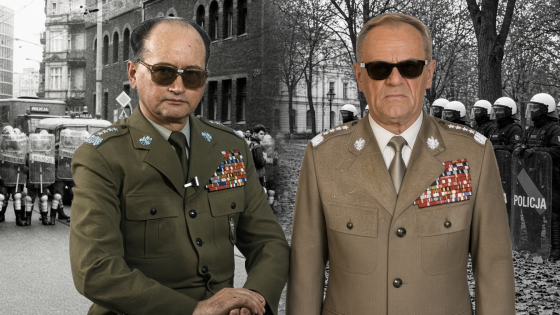
Anyone who still harbours any hope for a peaceful resolution to the situation surrounding the so-called Constitutional Tribunal crisis should realize that Donald Tusk and his gang have passed the point of no return. The actions of Tusk and his thugs—foremost among them Prosecutor General Waldemar Żurek—have repeatedly violated Poland’s state laws; furthermore, the concrete measures taken against state institutions and individuals who held positions in the previous government all but guarantee long prison sentences for them should they lose the elections in two years’ time.
Tusk’s intentions are clearly set out in what is known as the address of October 31st. Let us examine its key points:
The most significant aspect of this is the justification for his coup d’état—a move in which he not only defends his seizure of total control over the state but also identifies the key individuals allegedly responsible for the crime of “high treason,” (crimes, which in fact he commits) declaring that they will be deprived of their liberty for the noble purpose of saving the state and its democracy:
“The assault on the Constitutional Tribunal and its judges is yet another phase in the process of dismantling the rule of law in Poland—a process driven by the Law and Justice (PiS) party, as well as Presidents Duda and Nawrocki.”
Naturally, Tusk’s address is not intended for a Polish audience; rather, it is aimed primarily at European and global public opinion—an audience that will surely be pleased to see Donald Tusk and his government “save” a democracy supposedly under threat.
In the same vein, Donald Tusk “explains” how much patience he invested in an amicable process to resolve the crisis:
“Together with the parliamentary majority, I made attempts to fix the Constitutional Tribunal. No one had any doubt that the Tribunal, in the form imposed by PiS, was not a genuine court. That was the assessment of international institutions, Polish legal authorities, and the general public. We proposed resolutions and legislation to all political forces—as well as to both presidents—that would have enabled a collaborative restoration of the rule of law. It was all to no avail. Everything was blocked by the president and PiS.”
In the paragraph above, Donald Tusk sheds crocodile tears for the benefit of the global public, feigning great effort in his attempts to resolve the crisis of democracy in Poland through peaceful means. The international community—which, by and large, understands nothing about the situation in Poland—will be pleased that the crisis has been averted, even if by somewhat “forceful” methods. End of story.
The final point in Donald Tusk’s agenda is a pledge to utilize the forces at his disposal:
“It is the duty of the executive branch—and therefore my duty—to ensure his safety and the conditions for him to carry out his work. And I intend to fulfil that duty. Poland is strong, democratic, and determined. It has not perished, and it shall not perish. Thank you very much.”
And this is now an overt threat and a harbinger of what is inevitably set to happen—the forcible takeover of all institutions that still resist the supremacy of HIS (Tusk’s) government, and the imposition of a state of emergency for an indefinite period.
Some—the more naive among us—might ask: “And what about public opinion? What about the leaders of other nations?” The answer is: nothing—or they might even pat Donald Tusk on the back in approval for saving democracy.
An independent Poland could never count on the European Union. The European Commission (through spokesperson Louise Bogey and Commissioner for Democracy, Justice and the Rule of Law Michael McGrath) has issued statements that various media outlets (including Politico, Euronews, Onet, and Polityka) interpret as support for the government:
-
- The Constitutional Tribunal must be able to function in accordance with the Polish Constitution and in compliance with the case law of the Court of Justice of the European Union.
- The appointment of eight new members to the Constitutional Tribunal falls within the constitutional powers of the Sejm—a point confirmed by the Venice Commission in its opinion of October 13, 2026.
- Reference was made to the interim measures issued by the European Court of Human Rights on May 5, 2026, which oblige the Polish authorities to refrain from obstructing the judges elected by the Sejm in March 2026 from taking office and performing their duties.
Politico stated explicitly: “Commission backs Tusk,” in the context of an escalating dispute with President Karol Nawrocki.
And what about Donald Trump—a great friend of President Karol Nawrocki, who hosted his Polish ally at the White House on several occasions?
No, Donald Trump has not publicly addressed the crisis surrounding the Constitutional Tribunal in Poland—neither the long-standing dispute over the legitimacy of the Tribunal’s composition (dating back to 2015) nor the escalation that occurred in late October 2026 (involving the suspension of Tribunal President Bogdan Święczkowski and the Vice-President by Judge Anna Korwin-Piotrowska, subsequent protests, and the intervention of President Karol Nawrocki).
Searches across media outlets and on X (including Trump’s own account) reveal no direct comments, statements, or posts on the matter. While U.S. Ambassador to Poland Tom Rose did call for calm—emphasizing that the United States would not interfere in Poland’s internal affairs.
In short, Donald Trump is letting his great ally drown without even offering a symbolic helping hand.
At this point, we would like to draw the reader’s attention to events that took place during the first days of September. Polish Foreign Minister (and Deputy PM) Radosław Sikorski met U.S. Secretary of State Marco Rubio at the Biltmore Hotel in Miami (Florida, 2 September 2025). They discussed:
-
- Polish-U.S. security and energy cooperation
- The U.S. military presence on NATO’s eastern flank (including in Poland)
- Prospects for a lasting end to the war in Ukraine
They also jointly awarded the Lech Wałęsa Solidarity Prize to Cuban dissident Berta Soler. Sikorski presented Rubio with a historic 1989 Solidarity poster (“W samo południe”) signed by Lech Wałęsa.
More importantly, the two men met again—at a critical moment, while a commotion was unfolding outside the Constitutional Tribunal headquarters.
It happened while Rubio hosted the G20 foreign ministers’ meeting in Atlanta, Georgia (30–31 October 2026), with Sikorski participating as Poland was invited as a full participant/guest. Sikorski sat next to Rubio during sessions. On 31 October, Rubio took several foreign ministers (including Sikorski) to the Florida Gators vs. Georgia Bulldogs college football game at Mercedes-Benz Stadium in Atlanta and posted group photos.
One can only surmise that Radek Sikorski promised something to Marco Rubio—something that prompted this key ally of President Nawrocki to throw his support behind the current Polish government. Could it have been an agreement to take a favourable stance on Act 447 on behalf of the Polish government? It would certainly serve to appease Donald Trump’s financial backers—namely, those associated with the “Holocaust industry” and those who helped fund Trump’s presidential campaign.
In any case, Poland stands alone, without international allies who could speak up on its behalf.
What does “in the near future” mean?
It means something akin to what we experienced in December 1981—martial law—with Prime Minister Donald Tusk now taking the place of General Jaruzelski. Only this time, there is no international public opinion sympathetic to the Polish cause; there is no President Ronald Reagan, nor is there a Margaret Thatcher.
