
On Saturday, November 7, 2026, at approximately 3:00 p.m., a fatal shooting occurred in the Main Market Square and the surrounding streets in the heart of Kraków. The perpetrator, 24-year-old Michał Oksiński from Ostrowiec Świętokrzyski, killed 6 people and wounded 16, including two police officers.
The current government of Donald Tusk immediately attempted to exploit this tragedy for political purposes. During a press conference on Saturday, Tusk’s Minister of the Interior, Marcin Kierwiński, promptly “suggested” that the perpetrator held far-right political views—views which, in his opinion, could have led him to commit these criminal acts. Although he did add that the actual causes were being investigated by the police, left-leaning media outlets worldwide nonetheless began blaming the “Nazi” opposition and the conservative segment of society for these crimes.
As it soon turned out, however, the reality was diametrically different from what had been “suggested.” Michał Oksiński proved to be an individual with leftist, globalist views and inclinations typical of anti-fascist (Antifa) circles, along with a drive to impose his own convictions upon others—all of this coupled with transsexuality and a range of other “modern” social constructs, devised by global social engineers to sow confusion in the minds of young people with fragile psyches.
And here, something happened that neither Tusk nor his associates had foreseen: a shift in the perception of international conservative influencers on social media. It was a development unanticipated by the architects and perpetrators of the coup d’état currently unfolding before our eyes in Poland. Until now, few conservatives globally had paid heed to the ominous “changes” being forcibly imposed by Tusk and his cronies upon the legal and political system of the Republic of Poland. However, the shedding of blood—and the deceitful Polish Prime Minister’s attempt to exploit it for political gain—drew widespread attention to this vile conduct. Furthermore, genuine conservatives across social media began to link the tragedy in Kraków to the ongoing coup d’état and the attempt to enact the criminal “3003” bill in Poland.
And so, until now, acting under the instruction of his European superiors and benefactors, Tusk has operated with impunity—confident that those who tasked him with safeguarding the “European order” would guarantee him free rein. However, in the so-called West, there is growing negative attention directed toward the actions of Donald Tusk’s government and his clique.
All the official assurances from Tusk and his associates regarding the restoration of the rule of law were never intended for a Polish audience; rather, they were designed to reassure the public—via Western mainstream media—that everything in Poland is going well, and that the rule of law, allegedly violated by the previous Law and Justice (PiS) government, is being restored.
For readers outside of Poland, it should be explained that this “restoration of the rule of law” is an overt coup d’état in the Republic of Poland, sponsored by the elites of the European Union. The legal system in Poland was structured by the collapsing communist regime (1989–91) in such a way that, firstly, it guaranteed former members of the ruling apparatus complete immunity from legal liability for crimes committed while they held power between 1944 and 1989; and secondly, it ensured their security and impunity for their actions in the so-called “free Poland.”
It is no surprise that this process took place around the same time the European Economic Community (EEC) was being formally transformed into the European Union—a process culminated by the Maastricht Treaty, which entered into force on November 1, 1993, and officially turned the EEC into the EU. It should be recalled that the architect of the specific concept behind the European Union was an Italian communist and proponent of the Communist International—a man named Altiero Spinelli—to the extent that a blueprint for the EU structure was even named after him, entering the history of the EU as the “Spinelli Plan.”
European globalist elites, much like the post-communist “elites” in Poland, shared objectives that were not coincidental. First and foremost, they sought to secure impunity for their actions by establishing a legal framework that would cement their control over Europe and guarantee them absolute legal immunity, regardless of the illicit schemes or fraudulent acts they might commit.
Should anyone have any doubts about this, I would point to the recent scandal known as “Qatargate” and all the individuals involved in it who continue to serve as EU officials without facing any legal consequences. Another example is the so-called “Pfizergate” scandal, which concerns the actions of European Commission President Ursula von der Leyen and her approval of the EU’s largest vaccine contract—an agreement covering up to 1.8 billion doses of the Pfizer/BioNTech vaccine (with a potential value reaching tens of billions of euros). This deal was arranged via text messages (SMS) exchanged between her and Pfizer CEO Albert Bourla during negotiations for COVID-19 vaccines in early 2021. Despite widespread outrage, the Commission refused to disclose the messages; as a result, nothing happened, no convictions were handed down, and Ursula von der Leyen remains the head of the Commission.
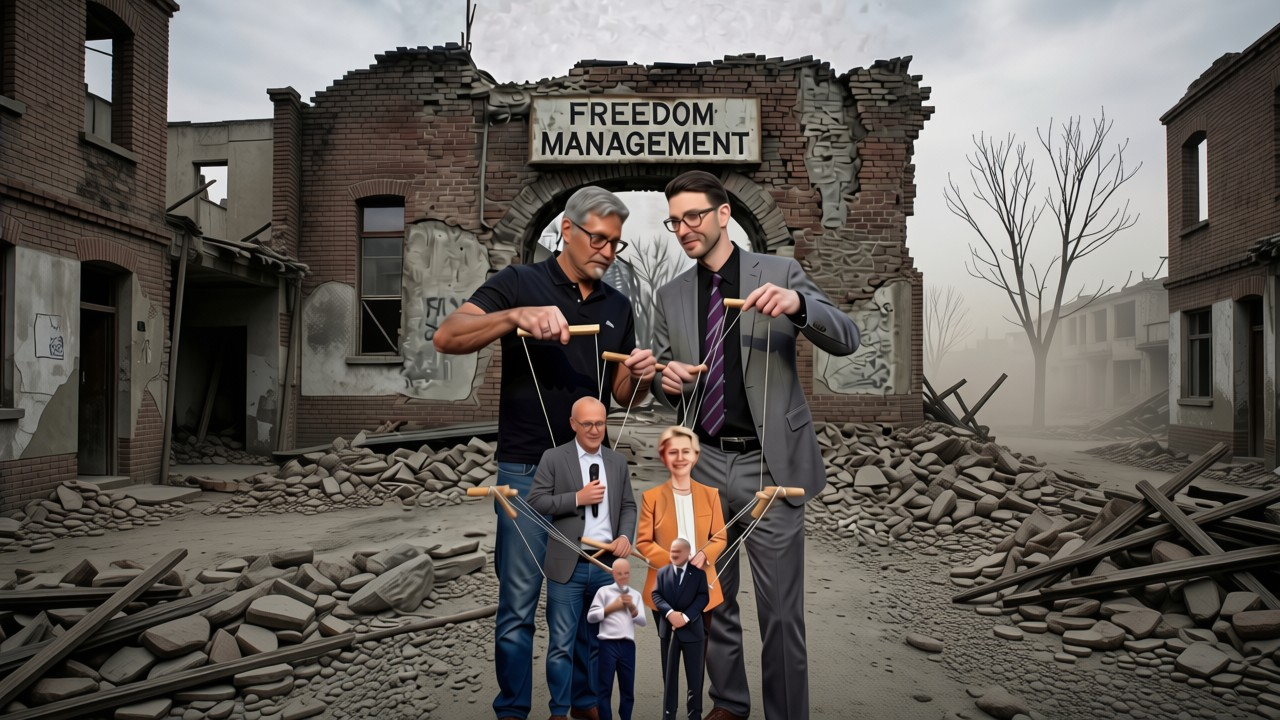
Similarly, the EU acts as a guardian of the legal order within every member state, where puppets linked to the Union are tasked with safeguarding the “legal order” of the European Union—at every level. While maintaining the appearance of a so-called “liberal democracy”—with general elections still being held—the Union’s interference becomes increasingly apparent whenever an elected government or president happens to disagree with the “only correct” line dictated by the EU’s own version of a Comintern. Examples of this include the recent presidential elections in Romania, as well as the fiscal pressures exerted on Orbán’s government in Hungary and the Law and Justice (PiS) administration in Poland.
Thus, the real problem for Poland—and for those who wish to preserve the country’s sovereignty—began in 2015, after Law and Justice (PiS) not only won the parliamentary elections but also saw its candidate, Andrzej Duda, become President of the Republic of Poland. Having a decisive majority in parliament and the certainty that the president will not sabotage the passed laws. The PiS government decided to carry out the judicial reform, announced before the election.
It should be emphasized here that the judicial reforms implemented by the Law and Justice (PiS) government were always carried out in accordance with established constitutional laws; existing law was not violated, and opposition politicians were neither persecuted nor placed in detention. The fact that institutions tasked with upholding the law and the rule of law were progressively staffed with individuals who were not necessarily fanatically pro-EU and sympathetic to PiS does not constitute anything illegal, nor does it differ from practices found in other countries characterized as liberal democracies (e.g., the United States Supreme Court). In reality, this is what the process entails; otherwise, one would end up with a static regime, devoid of any possibility for change.
I would like to remind you that the conservative and patriotic government of Viktor Orbán in Hungary was, at that time, implementing similar changes—changes which, much like those in Poland, met with a vicious reaction from Brussels, that is, from the EU elites.
Throughout the two terms of the Law and Justice (PiS) government, there was an ongoing confrontation between the Polish administration and the EU leadership, manifested in a persistent smear campaign within “pro-EU” mainstream media—both in Europe and globally. In these media, Poland was portrayed as a country teeming with bloodthirsty, fascist thugs, while patriotic gatherings and marches were depicted as neo-Nazi feasts. At the same time, almost every week, throughout the eight years of the Law and Justice (PiS) government, one high-ranking EU apparatchik or another would express concerns about the destruction of the rule of law in Poland. This was also reflected in the practical steps taken by the EU’s “Comintern”—such as withholding funds due to Poland, establishing committees to investigate the state of the rule of law in the country, and imposing penalties for non-compliance with environmental policies.
In effect, this was intended to serve as a scare tactic for audiences worldwide and instilling into them a sense of dread regarding a resurgence of fascism and the potential for some sort of international conflict, or, at the very least, painting a repulsive picture of a patriotic Poland. All of this was a way of preparing global opinion for the imposition of EU rule by force, with the aim of bringing the situation in Poland under control for the benefit of the ruling EU elites and effectively eliminating the opposition—to such an extent that, when these forceful methods are ultimately deployed, the global public will greet them with a sigh of relief.
Donald Tusk himself stated, quite early on and publicly, that breaking the law would be necessary in order to restore the rule of law. He made the remarks at a conference in the Polish Senate titled “Ways Out of the Constitutional Crisis”), attended by the speakers of the Sejm and Senate and various legal figures on 10 September 2024. Tusk argued that eight years of PiS rule had left the legal system “devastated,” full of interpretive grey areas and tools designed to undermine the constitutional order rather than strengthen it. He said restoring the constitutional order and the foundations of liberal democracy therefore required operating in the mode of “militant democracy”. In that context, he stated that the government would “probably make mistakes or commit actions that, according to some legal authorities, will be inconsistent or not fully compliant with the provisions of the law.” He added that he made daily decisions “with full awareness of the risk that not all of them will meet the criteria of full legality from the point of view of purists,” but that nothing excused the obligation to act.
The European Commission and officials such as Justice Commissioner Michael McGrath have publicly supported the Tusk government’s broader goal of restoring “judicial independence” the way it is perceived by Donald Tusk, thereby granting him full legal protection and impunity for his actions. Their statements emphasized that:
• The Constitutional Tribunal must be able to function in line with the Polish constitution and the case law of the Court of Justice of the EU (which amounts to placing EU law above the Constitution of the Republic of Poland).
• Appointing new judges falls within the powers of the Sejm (parliament), as confirmed by the Venice Commission (in other words, ignoring the role of the President of the Republic of Poland).
• Polish authorities are responsible for ensuring the court operates properly, with full respect for the rule of law expected by citizens (in other words, by endorsing the forcible takeover of the Constitutional Tribunal’s headquarters and the installation of judges who had not been confirmed by the President).
In short, the Tusk government had no intention of patiently reversing the changes introduced by the PiS government through lawful procedures. The decision to take over legal institutions in Poland by force had already been made—with the full blessing of EU elites.
And here we return to the tragic events in Kraków, when—for the first time in the history of the Republic of Poland—a young man dressed in military fatigues, wearing a helmet, a mask, and a Kevlar vest, opened fire, using military style assault rifle, on defenceless passersby in Kraków’s Main Market Square and on Stradomska Street.
In my view, this tragic event bears all the hallmarks of an operation secretly planned by special services—services that, ever since the inception of so-called independent Poland, have led a “life of their own,” with roots reaching deep into the communist-era intelligence apparatus, and which have never been dismantled by successive governments of the Republic of Poland.
In my opinion, the tragedy in Kraków was orchestrated by the secret services to provide the current government with yet another pretext for declaring a state of emergency. The following coincidences would seem to support this theory:
• On Friday, November 6, Donald Tusk spoke in parliament regarding the opposition’s activities: “In a few days—perhaps in a matter of tens of hours—you will see just how critically the Polish people view your conduct.”
• After the tragedy, accounts and information regarding the perpetrator, Michał Oksiński—found on social media and elsewhere online—were instantly removed by an invisible hand, as they completely contradicted the mantra that Oksiński was a fascist right-winger. Unfortunately for the authorities, quick-thinking and proactive internet users managed to download the content from Michał Oksiński’s private accounts onto their own devices.
• Content taken from Michał Oksiński’s account clearly indicated his left-wing views, as well as a fascination with transgenderism and Antifa.
• Dozens of hours later—and only five hours after the attack in Krakow—Minister of the Interior Marcin Kierwiński said of the perpetrator: “Everything indicates that he was fascinated by far-right ideologies.” By the time he uttered these words, Michał Oksiński’s social media account had already been deleted.
• A far greater massacre was likely prevented by a accidental encounter with a two-officer police patrol that happened to be at the scene of the tragedy, rather than by a specially dispatched police rapid-response unit, which should have been dispatched to the scene within minutes of reports about the shooting.
• The reaction of the prosecutor’s office—which accepted a notification regarding the potential commission of a crime by police officers—is strangely sluggish. In my view, this suggests that the authorities were not at all pleased with the officers’ “premature” and “spontaneous” response to an attack by a mentally unstable mass murderer. While the law requires the prosecutor’s office to examine allegations brought before it, it also grants the authority to dismiss them immediately if they are deemed “frivolous.” The fact that the prosecutor’s office has accepted these nonsensical allegations and has been in the process of reviewing them for several days now may point to a hidden, sinister intent on the part of the higher authorities.
• Another strange occurrence linked to the Kraków massacre involves video clips circulating on the Internet. Mostly derived from CCTV footage, these clips frequently bear the “RT” (Russia Today) watermark. It should be noted here that a tacit cooperation between Polish intelligence services and their Russian counterparts is an open secret, often discussed behind the scenes. How else could it be possible for the video reels from many different cameras and angles from the CCTV to have ended up in the hands of RT so rapidly?
The unplanned intervention by two young police officers caught the authorities by surprise—they simply hadn’t expected it. Nor did they anticipate such a swift reaction from internet users, or the fact that, by resorting to an act of violence, they would draw the attention of the conservative public—both to themselves and to the dramatic situation in Poland.
However, these events—unexpected for Tusk’s team—merely delayed his planned total takeover of the state It is my view that Donald Tusk and his clique have no intention of backing down regarding the Constitutional Tribunal—which they have taken over illegally—and recent events suggest they are prepared to resort to even the most drastic measures, if only to reassure their EU benefactors that they have everything under control.
What can we expect before Christmas?
• The imposition of a state of emergency under any pretext.
• The closure of all media outlets independent of the current government.
• The suspension of parliamentary operations.
• A declaration by a Constitutional Tribunal—illegally “organized” by the government—that the last presidential election was unlawful, followed by the forceful seizure of the Presidential Palace and the arrest of the President himself.
• The assumption of the office of President of the Republic of Poland by the communist Czarzasty (in his capacity as Speaker of the Sejm).
• The arrest of key opposition leaders and prominent figures associated with independent media.
• The cancellation of the upcoming parliamentary elections for an indefinite period—until the “overturning of democracy” is complete.
Of course, plans cannot always be realized exactly as they were intended. Let us hope that circumstances will arise which thwart the plans of the European Union and Donald Tusk, making it impossible for them to be carried out.
